

Michael Gallagher’s “Our Weather’s Psychrometric Shock Absorber” Featured in Sol Air September Issue
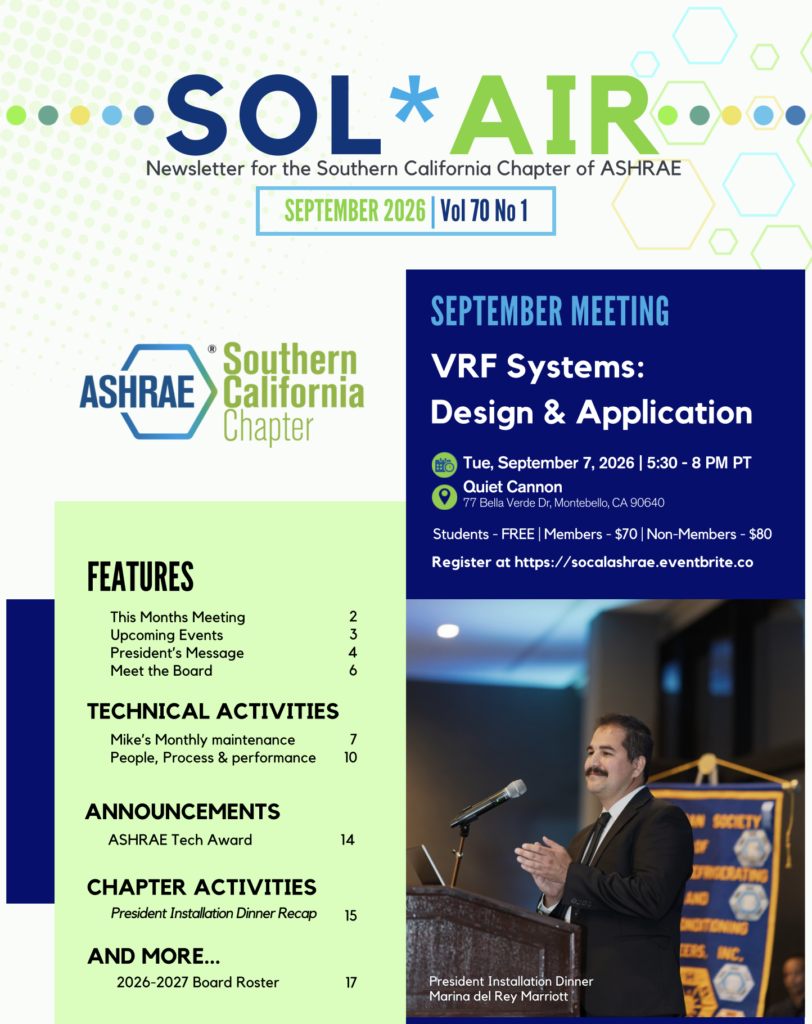
Michael Gallagher, PE, fASHRAE, President of Western Allied Corporation, has a column in the September 2026 issue of Sol Air, the newsletter of the ASHRAE Southern California Chapter. In “Our Weather’s Psychrometric Shock Absorber,” part of his Mike’s Monthly Maintenance series, Mike traces the history of psychrometrics and connects it to the weather we experience every day.
A Lesson Born in a Humid Summer
The column grew out of a long stretch of unusually humid weather in Southern California this year. With a strong El Niño, wet bulb readings stayed well above what ASHRAE design data would suggest for more than five weeks. That sparked plenty of discussion at Western Allied and carried into the in-house engineering classes Mike has been teaching.
Willis Carrier and the Birth of Psychrometrics
Mike retells the story of Willis Carrier as it was passed down to him at Carrier’s post-grad course in 1980. In 1902, Carrier was standing on a Pittsburgh train platform on a foggy morning, thinking about a Brooklyn lithographer whose ink kept running in humid weather. Seeing the dew-soaked steel railings, he reached the realizations that led to his 1911 paper, Rational Psychrometric Formulae, and to the psychrometric chart that accompanied it. In Mike’s view, that chart is the most valuable contribution ever made to the HVAC discipline.
Why Humidity Is Our Weather’s Shock Absorber
Mike then brings the science back to the weather. On a clear summer day, Death Valley sees a daily temperature range of about 35°F, downtown Los Angeles about 20°F, and humid Corpus Christi, Texas, about 16°F. The difference is moisture in the air. As temperatures fall at night, water condenses into dew and releases heat, slowing the temperature drop. The next day, that dew evaporates and absorbs heat, moderating the rise. With little moisture, Death Valley has no such buffer.
As Mike puts it, moisture in the air is what moderates our temperature, a good thing to remember the next time you squeegee your windshield.
Read the September 2026 issue of Sol Air here.
